Printing a book is an exciting step for authors, publishers, businesses, schools and organisations. However, one of the first questions most people ask is: how much does it cost to print a book in Singapore?
There is no single price that applies to every book. The final cost depends on several factors, including the number of pages, book size, paper type, colour printing, binding, cover finishing and quantity.
Understanding these factors can help you prepare a realistic budget and choose printing specifications that suit your project.
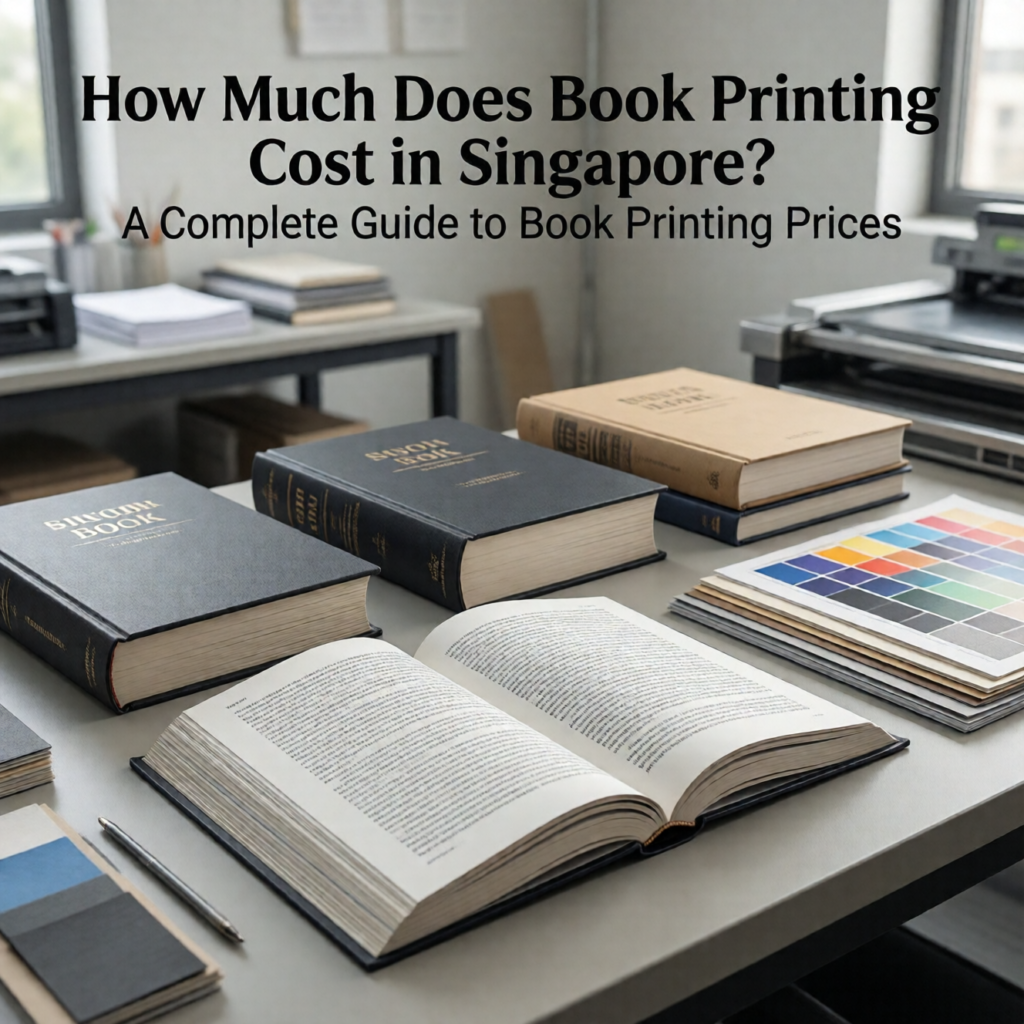
Whether you are printing a novel, children’s book, textbook, company publication, workbook or self-published title, this guide explains the main factors that affect book printing cost in Singapore.
Table of Contents
- What Determines Book Printing Cost?
- Number of Pages
- Book Size
- Colour or Black-and-White Printing
- Paper Type and Thickness
- Cover Options
- Binding Methods
- Printing Quantity
- Finishing Options
- How to Reduce Book Printing Costs
- What to Include When Requesting a Quote
- Final Thoughts
1. What Determines Book Printing Cost?
The cost of printing a book is influenced by both the physical specifications of the book and the quantity being produced.
Some of the most important factors include:
- Number of pages
- Finished book size
- Paper type
- Paper thickness
- Colour or black-and-white printing
- Cover material
- Binding method
- Cover finishing
- Printing quantity
- Additional finishing requirements
For example, a 100-page black-and-white paperback will generally require a different production process from a 300-page full-colour hardcover photo book.
This is why a printer will usually ask for detailed specifications before providing an accurate quotation.
2. Number of Pages
The number of pages is one of the most obvious factors affecting the cost of a printed book.
A book with fewer pages requires less paper and generally requires less printing time. A longer book requires more materials and production resources.
For example, a short booklet containing 40 pages will have very different production requirements from a 300-page novel.
However, adding pages does not necessarily mean that the total price increases at exactly the same rate. Printing costs can depend on how the pages are produced, assembled and bound.
Authors should therefore provide the printer with the final or estimated page count when requesting a quotation.
It is also important to remember that the cover may be calculated separately from the internal pages.
3. Book Size
The physical size of a book can also affect the overall printing cost.
Common book formats include smaller paperback sizes, standard novel formats, A4-style books and square formats.
Larger books may require more paper per page, while smaller books can sometimes use paper more efficiently.
The ideal size depends on the purpose of the publication.
For example:
- Novels often use compact formats that are comfortable to hold.
- Textbooks may require larger pages for diagrams and tables.
- Children’s books may benefit from larger pages and illustrations.
- Workbooks may require sufficient space for writing.
- Photo books may use larger formats to showcase images.
Choosing a standard and practical book size can sometimes help simplify production and control costs.
4. Colour or Black-and-White Printing
Colour printing is another major factor to consider when calculating book printing prices in Singapore.
A black-and-white novel with primarily text-based content may have different printing requirements from a full-colour children’s book or photography book.
Before choosing full-colour printing for every page, consider whether colour is actually necessary.
For text-heavy publications such as novels, reports or certain educational materials, black-and-white internal pages may be suitable.
For publications containing photographs, illustrations, charts or colourful designs, colour printing may be essential to achieve the intended result.
If your book contains a mixture of text and colour images, discuss the available printing options with your printer to determine the most suitable approach.
5. Paper Type and Thickness
Paper contributes to both the physical feel and the cost of a book.
Different types of paper are suitable for different applications.
For example, a novel may use paper designed for comfortable reading, while a photography book may benefit from paper that reproduces images with greater visual impact.
Paper thickness also affects the final thickness and weight of the book.
When selecting paper, consider:
- Readability
- Opacity
- Thickness
- Weight
- Surface finish
- Image reproduction
- Writing suitability
Choosing the thickest or most expensive paper is not necessarily the best solution.
The right paper should match the purpose of the publication while remaining within your budget.
6. Cover Options
The cover is another important part of the book printing quotation.
A basic softcover may be suitable for novels, manuals and many self-published books, while a more substantial hardcover can provide a premium appearance and additional durability.
Cover costs can depend on:
- Cover material
- Cover thickness
- Colour printing
- Cover size
- Finishing
- Binding method
The cover artwork should also be prepared according to the printer’s specifications, including the correct dimensions and bleed.
A professionally designed cover can make a significant difference to the appearance of the finished publication.
7. Binding Methods
Binding is both a practical and visual consideration.
Different books require different binding methods depending on their page count, intended use and desired appearance.
Common options can include:
- Perfect binding
- Saddle stitching
- Spiral binding
- Hardcover binding
Perfect binding is commonly associated with paperback books and can provide a clean, professional appearance.
Saddle stitching can be suitable for thinner publications, while spiral binding can be useful for workbooks and documents that need to open flat.
Hardcover binding can provide a more premium and durable presentation.
The most suitable option depends on your book rather than simply choosing the most expensive method.
8. Printing Quantity
The number of copies you print can have a significant impact on the cost per book.
Printing a larger quantity can often reduce the average cost per copy because certain setup and production costs are spread across more books.
For example, printing 500 copies may result in a lower cost per book than printing only a small number of copies, depending on the production method and specifications.
However, ordering a larger quantity also means spending more money upfront and storing more books.
Authors should therefore balance the unit price against their expected demand.
If you are self-publishing, it may be useful to estimate how many copies you realistically expect to sell rather than ordering a very large quantity simply to obtain a lower unit price.
9. Finishing Options
Additional finishing can change the final appearance and cost of a book.
Depending on the project, finishing options may include different cover laminations, coatings or special treatments.
For example, a matte finish can create a smooth and understated appearance, while a gloss finish can provide a more reflective surface.
Finishing can also provide additional protection against everyday handling.
When requesting a quotation, make sure any finishing requirements are clearly specified so that the quoted price reflects the actual finished product you want.
10. How to Reduce Book Printing Costs
There are several practical ways to manage your printing budget without sacrificing the professional appearance of the book.
First, choose a suitable book size rather than automatically selecting the largest format.
Second, consider whether every page needs to be printed in colour.
Third, select paper that matches the purpose of the book instead of choosing unnecessarily expensive stock.
Fourth, compare different binding options based on the intended use.
Finally, consider the quantity carefully. A larger print run may reduce the cost per copy, but only if you can reasonably use or sell the additional books.
The cheapest option is not always the best option. The goal should be finding a balance between quality, functionality and cost.
11. What to Include When Requesting a Quote
To receive a more accurate book printing quotation, provide as much information as possible.
Useful specifications include:
- Book title
- Finished size
- Number of pages
- Number of copies
- Colour or black-and-white pages
- Paper requirements
- Cover type
- Binding method
- Cover finishing
- Delivery requirements
You can also provide a print-ready PDF if the layout has already been completed.
Having these details ready makes it easier for a printing company to understand the project and recommend appropriate production options.
If you are unsure about the best specifications, explain how the book will be used. A professional printer can then help you identify suitable paper, binding and finishing choices.
12. Final Thoughts
The cost of book printing in Singapore depends on much more than the number of pages.
Book size, paper, colour printing, cover specifications, binding, finishing and print quantity can all influence the final quotation.
Instead of focusing only on finding the lowest price, consider what your readers will expect from the finished publication.
A novel may prioritise comfortable reading and affordable production, while a photography book may require high-quality colour reproduction and premium paper. A workbook may need durable binding and pages suitable for writing.
The best approach is to determine your requirements first and then request a quotation based on the complete specifications.
For authors, businesses, schools and organisations planning a new publication, understanding these factors can make the book printing process easier and help prevent unexpected costs.
With the right combination of format, paper, printing method, binding and finishing, it is possible to produce a professional-looking book while keeping the project within a realistic budget.