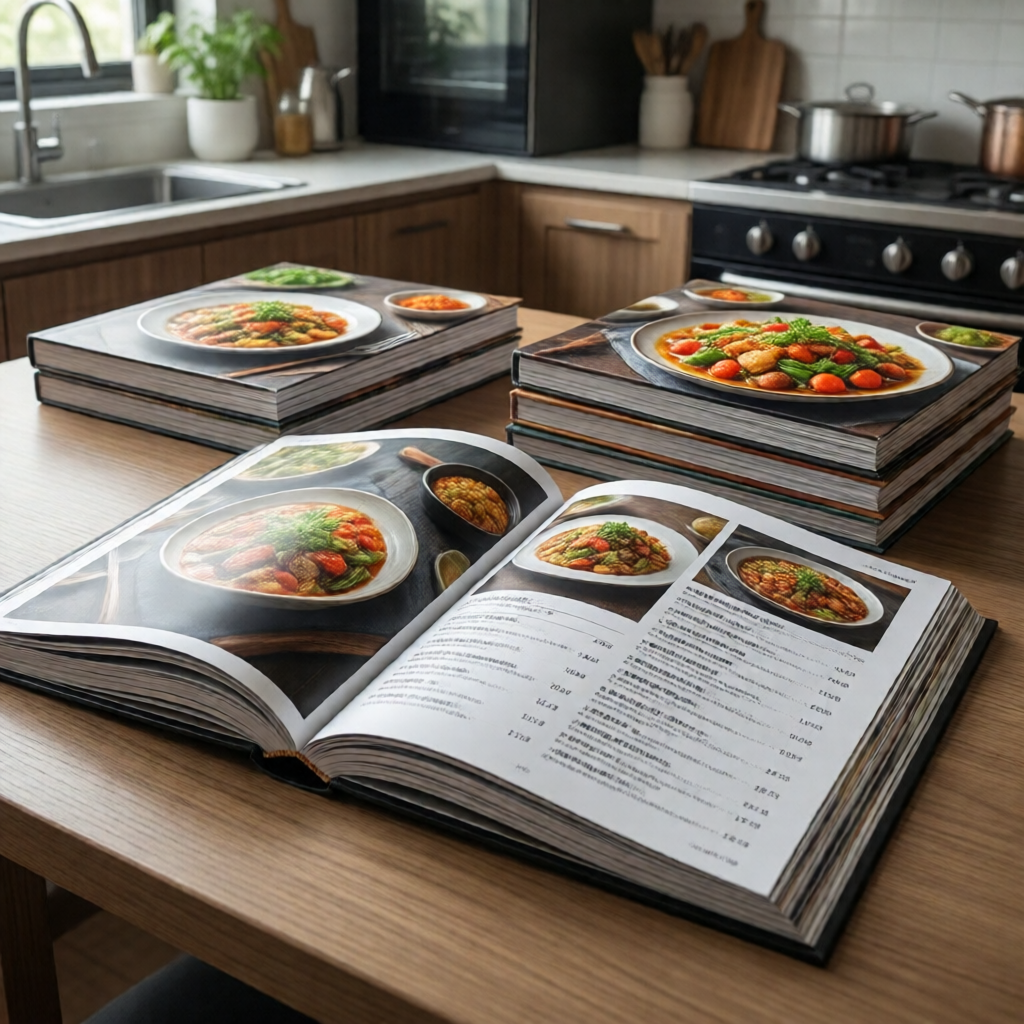
Creating a recipe book is a practical way to collect favourite family recipes, document traditional dishes, promote a food business or create a professional cookbook for sale. However, recipe books have different printing requirements from ordinary text-based books because they often combine recipes, food photography, instructions and tables.
Choosing the right paper, binding, page size and design can make a significant difference to the finished product.
Whether you are creating a family cookbook or preparing a professional publication, understanding the basics of book printing Singapore can help you make better decisions before sending your files for production.
Table of Contents
- Why Recipe Books Need Special Printing Considerations
- Decide the Purpose of Your Recipe Book
- Plan Your Recipe Book Structure
- Choose the Right Book Size
- Select Paper for Recipe Books
- Colour Printing for Food Photography
- Design an Easy-to-Read Recipe Layout
- Choosing the Right Cover
- Selecting a Suitable Binding
- Preparing Food Photographs for Printing
- Preparing Your Recipe Book Files
- How Many Copies Should You Print?
- Proofreading Before Printing
- Final Tips for Printing a Recipe Book
1. Why Recipe Books Need Special Printing Considerations
A recipe book is usually more visual than a standard book.
Readers may need to look at photographs, ingredient lists, preparation instructions and cooking times while using the book in the kitchen. The design therefore needs to balance appearance with practicality.
A recipe book may contain:
- Food photographs
- Ingredient lists
- Cooking instructions
- Preparation times
- Cooking times
- Serving sizes
- Nutritional information
- Tips and variations
- Introduction sections
- Indexes
Because of these different elements, the printing specification should be considered from the beginning of the project.
A beautiful design is useful, but the finished book should also be easy to read and handle.
2. Decide the Purpose of Your Recipe Book
Start by deciding how the recipe book will be used.
A family cookbook may be produced primarily as a keepsake. It might contain old family recipes, photographs and stories about where the recipes originated.
A restaurant or food business may use a recipe book as a promotional or educational publication.
An author may also create a commercial cookbook intended for sale.
These different purposes can influence your decisions about paper, binding, cover design and quantity.
For example, a family recipe book may focus on personal photographs and memories, while a commercial cookbook may require a more polished publishing design.
Knowing your audience will make the rest of the printing decisions easier.
3. Plan Your Recipe Book Structure
Before designing individual pages, establish the overall structure.
A recipe book could include:
- Front cover
- Title page
- Introduction
- Contents page
- Recipe chapters
- Cooking tips
- Ingredient information
- Recipe photographs
- Index
- About the author
Recipes can be grouped according to categories such as:
- Breakfast
- Starters
- Soups
- Main dishes
- Desserts
- Drinks
- Vegetarian recipes
- Family favourites
Consistent organisation helps readers find recipes quickly.
It is also useful to establish a standard layout for every recipe before formatting the entire book.
4. Choose the Right Book Size
Book size affects both appearance and usability.
A compact recipe book can be convenient for storage, while a larger format can provide more space for photographs and detailed instructions.
Consider how the book will actually be used.
If readers are expected to keep the cookbook open on a kitchen counter, a practical size and binding can make it easier to handle.
If large food photographs are an important part of the publication, a larger page format may allow the images to make a stronger visual impact.
Consider:
- Page dimensions
- Number of recipes
- Photograph size
- Text size
- Storage
- Portability
- Overall production cost
Choose the page size before completing the final layout because changing dimensions later may require the entire book to be reformatted.
5. Select Paper for Recipe Books
Paper selection is particularly important for recipe books because they frequently contain photographs.
The paper needs to provide a suitable surface for both text and images.
When comparing paper options, consider:
- Thickness
- Opacity
- Surface texture
- Image reproduction
- Readability
- Overall weight
A paper that works well for a novel may not necessarily be the best choice for a highly visual cookbook.
If the recipe book contains full-page food photography, ask your printer about paper options that can reproduce photographs effectively.
It can also be useful to request physical samples before making the final decision.
For more information about paper selection, see a guide to choosing the right paper for book printing.
6. Colour Printing for Food Photography
Food photography is often one of the most important visual elements of a recipe book.
Colour printing allows photographs to show ingredients, textures and presentation more effectively.
However, photographs that look excellent on a computer monitor may not necessarily look identical when printed.
Before production, review important photographs carefully.
Check:
- Brightness
- Contrast
- Colour balance
- Cropping
- Image resolution
- Placement on the page
Avoid using unnecessarily low-resolution images.
If a recipe book contains hundreds of photographs, image preparation should be completed well before the final print file is submitted.
Colour printing can also affect the overall production budget, so the number of colour pages should be considered when planning the project.
7. Design an Easy-to-Read Recipe Layout
Good recipe design should make cooking easier.
Readers should be able to quickly identify the ingredients and instructions without searching through large blocks of text.
A typical recipe layout might include:
Recipe Name
Short introduction or description
Ingredients
- Ingredient 1
- Ingredient 2
- Ingredient 3
Instructions
- Prepare the ingredients.
- Follow the cooking process.
- Complete the final preparation.
Additional information such as cooking time, preparation time and serving size can be placed near the recipe title.
Use consistent typography throughout the book.
Headings should have a clear hierarchy, while body text should remain comfortable to read.
Avoid using too many fonts or decorative elements that distract from the recipe itself.
8. Choosing the Right Cover
The cover is particularly important for a cookbook because food is highly visual.
A strong recipe book cover might feature:
- A professionally photographed dish
- Several dishes arranged together
- Ingredients associated with the recipes
- A clean typographic design
- A distinctive illustration
- A combination of food photography and title text
The title should remain clear even when viewed from a distance.
Avoid placing important text over a busy photograph unless sufficient contrast is provided.
The cover should also match the audience.
A family cookbook might use a warm and personal design, while a professional culinary publication may require a more sophisticated visual style.
For more guidance, review a book cover design and printing guide before finalising the artwork.
9. Selecting a Suitable Binding
The right binding depends on the size and purpose of the recipe book.
Common options include paperback and hardcover formats, along with different binding styles suited to various page counts.
Consider how the reader will use the book.
If the cookbook needs to remain open while following a recipe, the ability of the binding to open comfortably can be especially important.
For a premium cookbook intended as a gift, hardcover binding can provide a more substantial appearance.
For a practical everyday cookbook, a simpler binding may provide a balance between usability and cost.
You can compare different options using a book binding guide before making your final choice.
10. Preparing Food Photographs for Printing
Photography can determine whether a recipe book looks professional.
Use the highest-quality original photographs available and avoid repeatedly saving and compressing image files.
Before placing images into your layout, check their:
- Resolution
- Orientation
- Cropping
- Colour
- Brightness
- Aspect ratio
Photographs should also be consistent where possible.
For example, if one recipe uses a close-up photograph while another uses a distant image, the overall book may feel visually inconsistent.
A consistent photography style can make the entire cookbook appear more professional.
11. Preparing Your Recipe Book Files
Before sending the recipe book to a printing company, review the complete print file.
Check the following:
- Page size
- Margins
- Bleed requirements
- Page numbers
- Image resolution
- Font embedding
- Colour settings
- Cover dimensions
- Image placement
- Chapter order
Make sure no important text or images are positioned too close to the page edges.
The cover should also be prepared according to the final binding and page specifications.
Using a book printing file preparation checklist can help reduce technical errors before production.
12. How Many Copies Should You Print?
The quantity depends on your intended use.
A family cookbook may only require a small number of copies.
A restaurant or culinary business may need more copies for customers, promotional activities or staff use.
If the recipe book will be sold, consider expected demand before deciding on the first print run.
Printing too many copies can create unnecessary storage requirements, while printing too few may result in the need for another production run sooner than expected.
For smaller projects, short-run book printing can be a practical solution.
Discuss the quantity with your printer and compare the cost difference between several possible print runs.
13. Proofreading Before Printing
Recipe books require particularly careful proofreading.
A small mistake in an ingredient quantity or cooking instruction can change the result of a recipe.
Check every recipe for:
- Ingredient quantities
- Ingredient names
- Cooking temperatures
- Cooking times
- Serving sizes
- Instructions
- Spelling
- Punctuation
- Recipe numbering
- Photograph captions
It is useful to have another person review the recipes because authors can easily overlook errors in their own writing.
Also check that every photograph corresponds to the correct recipe.
Before approving a large print run, review a physical proof if one is available.
14. Final Tips for Printing a Recipe Book
Before sending your cookbook to production, use this checklist:
- Decide who will use the recipe book.
- Organise recipes into logical sections.
- Choose the final page size.
- Select appropriate paper.
- Prepare high-quality food photographs.
- Establish a consistent recipe layout.
- Design the cover.
- Choose the appropriate binding.
- Prepare the print-ready files.
- Proofread every recipe carefully.
- Review photographs and captions.
- Check the physical proof.
- Confirm the final quantity.
A recipe book should be attractive, but practicality is equally important.
The reader should be able to locate a recipe quickly, read the instructions comfortably and use the book without struggling with the layout.
Conclusion
Printing a recipe book requires more planning than simply placing recipes into a document and sending it to a printer. Paper, colour reproduction, photography, layout, cover design and binding all contribute to the final result.
Whether you are creating a family cookbook, a restaurant publication or a commercial recipe book, starting with a clear plan can help you avoid expensive changes later.
With the right specifications and careful proofreading, recipe book printing Singapore projects can turn your collection of recipes into a professional physical publication that readers can enjoy for years.